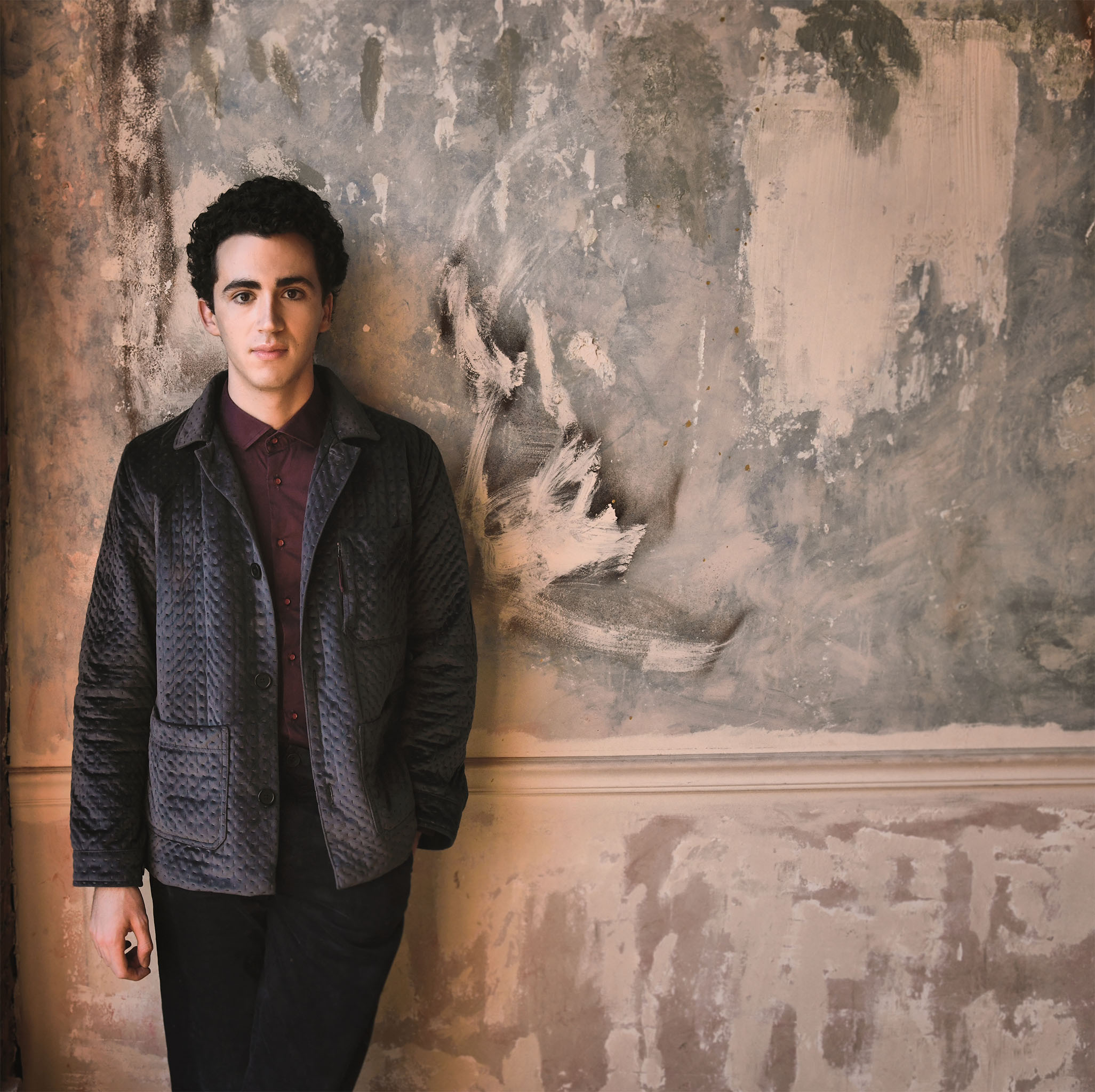
Selected reviews
Press
A daring recital [...] Extraordinary contrapuntal clarity [...]sparkling shifts in voicing to bring out inner lines — admirable extremes of expression.
Young Concert Artists presented its latest laureate, Kiron Atom Tellian, in a daring recital Tuesday night in the Kennedy Center Terrace Theater. The 23-year-old Austrian pianist focused on the virtuosic form of the romantic etude, mixing examples by Chopin, Scriabin, and Robert Schumann.
Tellian opened the program with a non-etude, Scriabin’s Piano Sonata No. 2, subtitled “Sonata-Fantasy.” With technical challenges a-plenty, the pianist displayed some of the finesse side of his musicianship, for which he has won awards for playing Bach and Haydn, among others. In the more wistful first movement, he phrased the main motif, a triplet slowly receding in sound, like an ebbing wave.
The complex textures of the piece came across in meticulous detail, sometimes so much that the topmost layer practically evanesced out of existence. Tellian’s left hand is particularly powerful, booming in octaves that underpinned the first movement’s climaxes. The second movement, taken at a roiling Presto tempo, had little of that subtle approach, with a buzzing cloud of musical ideas surging in a stormy mass.
At the recital’s heart came a selection of thirteen etudes, alternating between works of Chopin and Scriabin, drawn from the former’s Op. 25 and from three of the latter’s sets. (A few selections were wisely shorn from the program published in advance).
The juxtaposition often revealed similarities between the two composers, as in the opening pairing of Chopin’s “Aeolian Harp” (Op. 25, no. 1) and Scriabin’s Op. 42, no. 1. Chopin’s whirring sextuplets and Scriabin’s opposition of nine notes in the right hand versus five in the left created a harmonic blur beneath a delicate melody.
Delicacy marked Scriabin’s Op. 42, no. 3 with measured trills in both hands creating a tinkling music-box effect.
The next two etudes from Chopin’s Op. 25 set highlighted the pianist’s interpretative strengths. The syncopations of No. 4 sounded jaunty but admirably shaped, with Tellian’s avoidance of an overly clipped staccato evening out the piece’s overall effect.
Tellian showed a masterful control of the parallel sixths in Chopin’s Op. 25, no. 8, partly by relaxing the tempo. Scriabin seemed to echo that work’s texture in his youthful Op. 8, no. 10. Scriabin composed the Op. 65 etudes a couple years before his death, with the right hand of no. 1 moving in disturbing parallel ninths. No. 3, with its lack of tonal center, prominence of tritones, and crushingly loud dissonance added a sound world far distant from the other etudes. The return to Scriabin’s romantic idiom in the last etude, Op. 8, no. 12, sounded jarring in contrast.
Tellian’s bespoke etude set paralleled Schumann’s Symphonic Etudes, with both of the non-variation etudes (No. 3 and 9) and two of the posthumous etudes restored from the composer’s cuts. A greater variety of touch kept the ear engaged throughout this long work. Extraordinary contrapuntal clarity distinguished Variation I, and lovely rubato marked Variation II. Melodic pings popped up in unexpected places in Variation III.
Tellian did not take all the repeats, but those he did observe, as in Variation IV and Posthumous Variation V, featured some sparkling shifts in voicing to bring out inner lines. The intense rubato of Variation VI and the odd French overture of Variation VII were stamped by admirable extremes of expression. Putting Posthumous Variation IV, in pensive minor, after Posthumous Variation V, set up an exciting push through the concluding variations. The full-throated rendition of the Finale, with its surprising shift to a different theme, again relied on the foundation of Tellian’s puissant left hand.
Referring to the “half of my family” with Armenian heritage, Tellian offered a reflective encore, an unspecified Armenian Dance by Komitas, the Armenian priest, folk-song collector, and composer. The music’s modal differences and folk-like simplicity made a bracing contrast to an ultra-refined evening.
They prepared the canvas for the soloist, who, without resorting to ostentatious virtuosity, articulated phrases, accents, and lyrical lines with remarkable freedom. Intriguing was how Tellian dissected the athletic, “Paganini-esque” score to extract its essence: the emotional and pianistic tone that had not existed before Chopin.
Two intense weeks. Emmanuel Tjeknavorian takes up his role as music director of the Orchestra Sinfonica di Milano, both in terms of his position and its home base. Following introductory concerts some months ago and the recent inauguration tour hosted at La Scala, the young conductor-violinist offers two bold concert programs to the audience at Largo Mahler. On the stands are Mendelssohn’s The Hebrides Overture, Schumann’s Violin Concerto, and Schubert’s “little” Symphony in C Major. On the morning of the 24th, in the chamber setting of the Teatro Gerolamo, he will perform as both a chamber musician and concertmaster alongside orchestra colleagues, presenting Schönberg’s Verklärte Nacht and Mendelssohn’s Octet, Op. 20. Meanwhile, this afternoon (at 4 PM), at the Auditorium di Milano, Tjeknavorian reprises the program that officially inaugurated his new artistic role. As in previous occasions, he shows a preference for straightforward, single-themed programs with traditional design. To this end, he included a short piece to “warm up” the orchestra (Berlioz’s Rákóczi March), a concerto in the first half (the sumptuous and rhapsodic First Concerto by Chopin), and, in the second half, a symphony or similar piece (Brahms’s Piano Quartet No. 1 in the electrifying version by Schönberg). He invites the audience to recognize the subtle thread that connects the pieces, not only to highlight his careful curatorial choices but also to underscore his commitment to making the orchestra’s musicians more versatile and curious. What matters most to this young conductor—exceptionally young for such a profession—is demonstrating how tradition can still teach and engage young performers in their twenties on stage (and perhaps bring others of the same age into the audience). This was evident in his interpretation of the well-known Chopin concerto with Kiron Atom Tellian at the piano—together under fifty years old. The piece was purged of salon-like virtuosity and presented as a bold, authorial declaration. Despite the creativity being somewhat chaotic in form and youthful in nature, it was anchored by mature perspectives: somber and already tinged with fatalism. In the introductions, the orchestra lit up the dense instrumental writing, emphasizing dynamics and timbres. The brushstrokes of color were sleek and raw, avoiding “romantic” gallantries. They prepared the canvas for the soloist, who, without resorting to ostentatious virtuosity, articulated phrases, accents, and lyrical lines with remarkable freedom. Intriguing was how Tellian dissected the athletic, “Paganini-esque” score to extract its essence: the emotional and pianistic tone that had not existed before Chopin. The heart of the program is there. Alongside it are interpretative flourishes, such as the dazzling (and, for Tjeknavorian, even unsettling) explosions of dance-like movements and Hungarian colors that tie Berlioz to Brahms’s concluding Rondo alla Zingarese. Irresistible. The enthusiasm they generate is well-deserved. Here, the conductor’s most distinctive qualities—an uncompromising attention to rhythm, intonation, and orchestral detail—find joyous and exuberant (yet not naïve) expression.
One enters a state of weightlessness — following, as if suspended, by the whims of the wind blown by the performer.
…an incredible combination of sensitivity and taste.
Gerd Klingeberg — Weser Kurier
Devilish, virtuoso, and simply: brilliant.
Badische Neueste Nachrichten
The bravura and maturity of his playing render speechless.
Kronen Zeitung
Mittelbayrische Zeitung
His ability to connect virtuosity and intimate sensitivity, explosive drama, longing and singing melodies was extraordinary.
Oberösterreichische Nachrichten
Salzburger Nachrichten
…experienced with countless and beautiful compositional techniques.